The Story of Sam and Minnie Klausner
The Tale of an American Jewish Family
 

Dedicated to our bubbes and zaydes, who had the wisdom and courage to come to this wonderful country.  Zichrono Livracha.  May their memories be a blessing.   
 

Select a page, or to view all the pages in order, click continue.


INTRODUCTION: a word from the webkeeper

In 1880, America, with a population of 50 million, was home to only 500,000 Jews. The great wave of immigration that began that year would bring here about 2.5 million Jews from Eastern Europe. So when a Jewish American, like me, rises at a family simcha to thank their ancestors who had the courage and wisdom to come here, chances are better than 80 percent that the Jews being praised had arrived during those years.

Thus, this site's Generations section, which began with Simpson Thorman and will end with a Jewish family from the Former Soviet Union, should have an example of a family from that great wave of Jewish immigration. My own grandparents had come to the US then - my mother's parents in 1894 from Lomz (today in Poland), and my father's parents in 1895 from Chernowitz (today in Romania). But they weren't Clevelanders. My "example" family must have come to Cleveland and stayed here. Then I read Violet Spevack's Cavalcade column in the September 19, 2008 Cleveland Jewish News. She wrote:

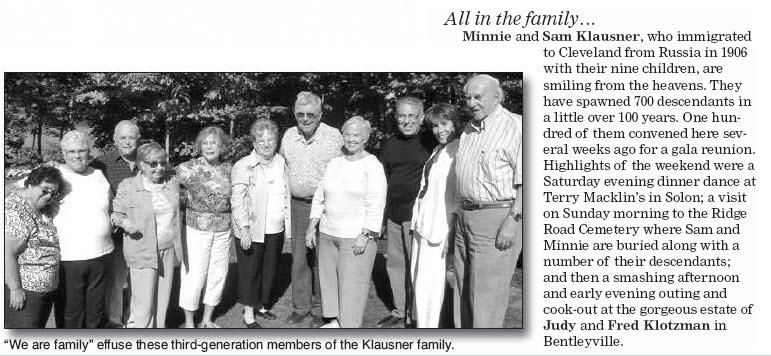
 "Minnie and Sam Klausner, who immigrated to Cleveland from Russia in 1906 with their nine children, are smiling from the heavens. They have spawned 700 descendants in a little over 100 years. One hundred of them convened here several weeks ago for a gala reunion. ......"

Hoping that this might be a good family to illustrate this wave of Jewish immigration, I called Judy and Fred Klotzman, who were mentioned in the CJN story. Then I met Fred, whose mother Mary was the oldest daughter of Sam and Minnie Klausner. He readily agreed to share the family's story and his own on these pages. Soon other members of the extended family of Sam and Minnie Klausner began to help.

These pages use materials they provided, plus my own research and links from some events in this family's progress to pages on trends in the life of Cleveland's Jewish community. I can't imagine my finding a more interesting family or one better to work with.

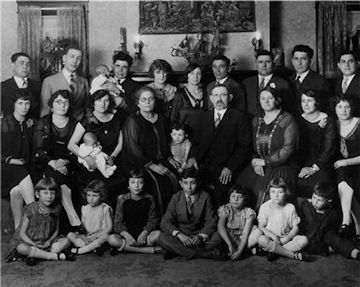
Klausner family 1926 >


Arnold Berger, webkeeper  January 2009


Where they came from - the Pale of Settlement

Some Jews would come from Galicia, then a province of Austria-Hungary, and from Romania, but most came from the Russian Empire. In the late 19th century, enlarged by its acquisitions of much of Poland, including Lithuania, Russia was home to the world's largest Jewish population. It restricted Jews without special permission to residing within the Pale (the boundaries) of Settlement. Five million Jews lived there, nearly all in towns (shtetlach) and villages, for even within the Pale, cities like Kiev were closed to Jews.

Russia would allow Jews who had become more "Russian" to live outside the Pale of Settlement. That could be done several ways. First, by conversion to Christianity. Then by higher education - but quotas of five percent Jewish enrollment, where Jews were perhaps 15 percent of the population, limited that option. Army service was also a way out. But conscription was dreaded, for it would take boys for up to 25 years into a strange, hostile setting that would try to convert them.

But Russia had no objection to its Jews leaving.
 

Source: the online copy of the 12 volume 1901-06 Jewish Encyclopedia

To compare maps of Europe in 1890 and 1930, click here.
 

The great wave of Jewish immigration  1880 - 1924

The wave begins


The pogroms that began in 1881 after the Tsar's assassination would lead to massive departures. A few Jews would leave for Palestine. Many would go to England or Canada. But most would leave for the United States where there were few barriers to entry, a growing economy, and relatives and others from their old home towns (landsmen) who would welcome them.

All across our nation, communities of Jews from eastern Europe began to form and grow. As the stories of economic opportunity and religious freedom in Die Goldene Medina (the golden land) made their way back to the shtetlach, others were encouraged to come. Thus, Jewish immigration would increase each decade.


Rosh Hashanah greeting card from the early 1900s.
Russian Jews, packs in hand, gaze at relatives
beckoning them to the United States.
Source: Wikipedia


Arrival of Jewish Immigrants

1880 - 1889 20,000 per year
1890 - 1899 30,000 per year
1900 - 1914 100,000 per year
Source: Library of Congress

These were the years when most ethnic communities - Poles, Russians, Slavs, Italians, Hungarians and more - were formed in Cleveland, which by 1920 would be America's fifth largest city. Jewish workers were welcomed into a garment industry (see ECH), largely owned by "German" Jews, that was almost as large as New York's. Cleveland offered Jewish immigrants better living conditions than New York's Lower East Side and it provided support from social welfare agencies established by the children and grandchildren of the first wave of Jewish settlers.

The great wave ends

Jewish immigration would be almost completely shut down by widely supported measures whose aim was to cut down on all immigration from eastern and southern Europe.

  • First, in 1917 admissions standards were raised and a literacy test imposed.
  • Then a 1921 law limited the immigrants from a country to three percent of the number from that country who had lived here in 1910. For persons from eastern or southern Europe it was a 75 percent reduction from prior years.
  • Last, the 1924 Quota Act rolled back the base year to 1890, when few southern or eastern Europeans were here, and cut the percentage to two. The combined limit for eastern and southern Europe was now less than 22,000.

But by 1924, 2.5 million Jews had arrived. Unlike other immigrant groups, where as many as one-third might return home, relatively few Jews would go back to the "old country." After all, what did they have to go back to? Though the tale of virtually none returning to the Old Country is a myth.  more ....  

Twenty-five percent of the world's Jewish population now lived in the USA. 

From 1880 to 1924 thousands of immigrant Jewish families came to Cleveland. Its Jewish population increased almost 30 fold, from 3,500 in 1880 to 100,000 in 1920. Now we look at the story of one of these families: Sam and Minnie Klausner.

Continue: Sam and Minnie Klausner - From Russia to Cleveland

Top of Page    Continue    Generations    About This Website    Cleveland Jewish History Home