B'nai
B'rith was founded in New York City in 1843.
Its first Cleveland Lodge was started here in 1853,
with Simpson Thorman as
president. It is, according to the
Encyclopedia of Cleveland History, our city's
oldest
service organization.
During the
Civil War years, Clevelander
Benjamin Franklin Peixotto, who was a
B'nai B'rith district and national leader,
led an effort to have the Midwest District
tax its members a dollar a year for a
charitable fund. Women from nine
cities were also asked to raise
money for the fund. In 1867 the
District decided to create a home
for Jewish orphans of the Civil War.
It was established in Cleveland
in 1868 and has evolved to become
our nationally-known Bellefaire.
Learn more ....
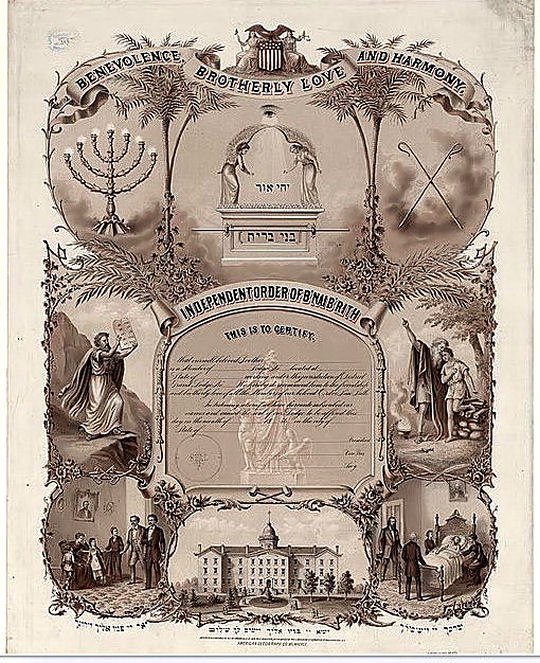
A Library of Congress exhibit
"From
Haven to Home" included this 1876
certificate of membership in B'nai B'rith.
The building shown at the bottom of the
certificate is the orphanage they
established in Cleveland in 1868.
In 1912 the
three Cleveland B'nai B'rith lodges -
Solomon #16, Montefiore #54 and Baron de
Hirsch #454 - merged and acquired
the building,
constructed in 1907 as Pythian Hall. The
organization served an important purpose,
bringing together active and involved Jewish
men to address issues of Jewish concern.
In
the years following, B'nai B'rith's
membership grew rapidly with 12 new lodges
formed in many neighborhoods. The lodges
were men-only. In 1933, Heights Chapter 119
was formed, for women. (In 1990 B'nai B'rith
Women separated from B'nai B'rith
International and in 1995 adopted a new name
- Jewish Women International.)
In the early
1940's, with all its members living far to
the east, in Glenville, Mount Pleasant or
the Heights, the
B'nai B'rith left the building. In 1954 the
Prince Hall Masons bought it.
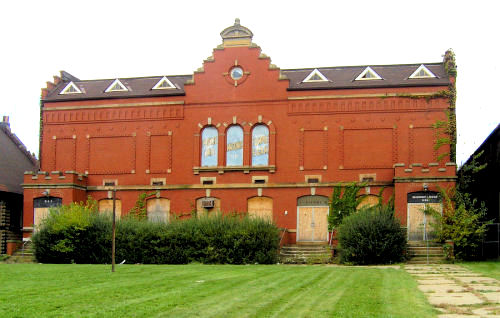
The former B'nai B'rith
building, looking abandoned, in 2007 Photo Arnold Berger
The building
occupies a place in Cleveland Jewish
history for it was there on Sunday
February 24, 1917 that Abba Hillel Silver,
only 24 and in his first pulpit in Wheeling
West Virginia, spoke. Alfred Benesch, then a
trustee of The Temple, was active in B'nai B'rith
regional affairs where he had met Rabbi
Silver, also an active member. Benesch may
have invited Silver to come to Cleveland. As
Benjamin Lowenstein, president of The
Temple, would later tell Rabbi Silver, all
the trustees had attended and knew
immediately that they had found their new
rabbi.
In the early 1940's, its members having
moved to Glenville and the "Heights, B'nai
B'rith no longer used the building. It was
acquired by the Prince Hall (African
American) Masons and lost in a fire in 2010.
More on the
loss of this landmark.
"Today's B'nai
B'rith International is a national and
global leader in the fight against
anti-Semitism and anti-Israel bias; provides
senior housing and advocacy on issues of
vital concern to seniors and their families;
helps communities in crisis; and promotes
Jewish identity through cultural activities."
(courtesy B'nai B'rith International)
●
